
Stories are one of the oldest technologies humans use to make sense of the world. Now, after centuries of storytelling craft, another technology — artificial intelligence — is learning to tell stories too. The idea that a machine might help write a novel once belonged in science fiction; today it’s real, accessible, and evolving fast.
This article explores how AI is being used to write novels, what it can and cannot do, how authors are already using it, the ethical and legal questions it raises, and what the near future may hold for creative writing. If you’re an author, editor, publisher, or a reader curious about machine-made fiction, this guide offers practical insight and strategy.
Table of Contents
ToggleHow AI writes (or helps write) fiction — the tech explained simply
AI used for novel writing is largely built on large language models (LLMs). These models are trained on massive amounts of text and learn to predict what comes next in a sequence of words. They don’t “understand” stories the way humans do, but they are excellent at producing fluent, contextually appropriate language.
Key AI techniques used in creative writing:
Prompting and generation: Give the model a seed — a prompt that may include a character, setting, and tone — and it produces paragraphs or chapters.
Fine-tuning: Models can be fine-tuned on specific authors or genres so their output mimics desired styles.
Controlled generation: Techniques like temperature control, top-k/top-p sampling, and instruction-following guide the model’s creativity level and coherence.
Plan-and-write workflows: The AI generates an outline or plot beats first, then expands each beat into scenes or chapters.
Editing and revision tools: AI suggests edits, rewrites awkward sentences, or tightens pacing.
Character & dialogue tools: AI helps create character biographies, voice profiles, and natural-sounding dialogue consistent across scenes.
Data-driven suggestions: Using analytics from prior drafts, AI can recommend structural changes, pacing fixes, or highlight continuity problems.
Practical ways authors are using AI today
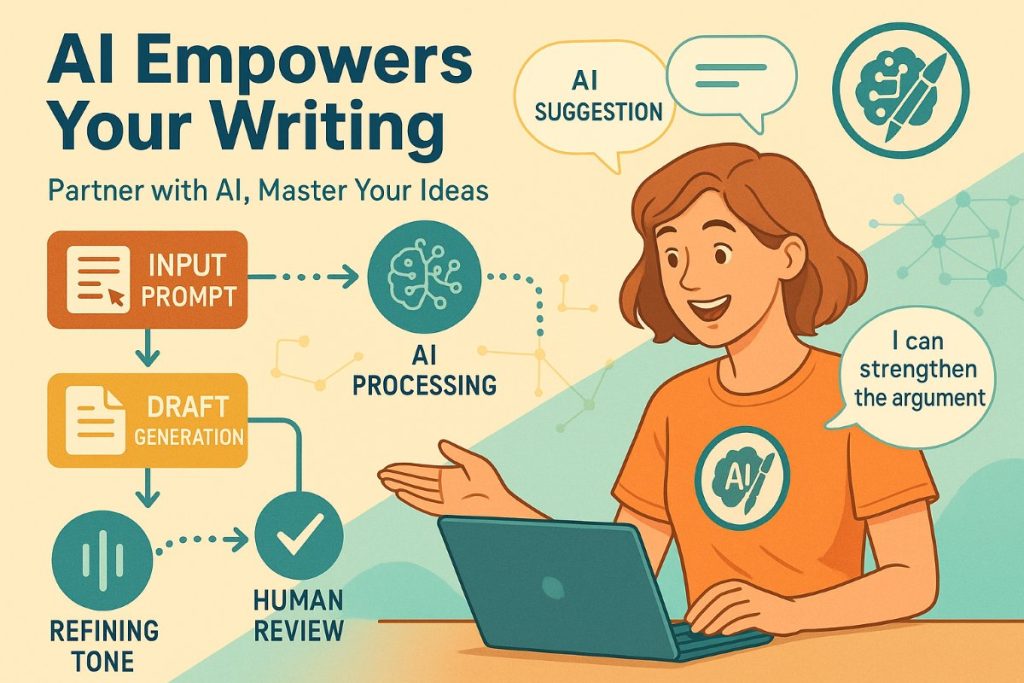
Authors approach AI along a spectrum — from cautious assistance to full collaboration. Here are common real-world uses.
1. Idea generation and overcoming writer’s block
Stuck on a plot? Authors prompt AI with a premise and receive multiple plot possibilities, twists, or character arcs in seconds. This speeds the brainstorming stage and produces unexpected directions.
2. Outlining and structure
Many writers ask AI to produce chapter-by-chapter outlines or beat sheets. This helps shape a novel’s structure before investing time in drafting.
3. Drafting scenes and dialogue
Writers sometimes ask AI to draft a difficult scene — a fight, a confession, a seductive dinner conversation — then edit the generated text into their voice. Dialogue generation is especially useful for creating back-and-forth that sounds natural.
4. Stylistic mimicry and rewriting
Using prompts or fine-tuning, AI can suggest rewrites in a specific tone (humorous, noir, lyrical) or emulate classic authors’ cadences to learn craft techniques or experiment with style.
5. Editing, proofreading, and line edits
Grammar and style suggestions from AI are fast and helpful. More advanced tools can flag pacing issues, sentence-level clarity, and excessive exposition.
6. Consistency and worldbuilding
AI keeps track of character names, timelines, and world details across large manuscripts — catching continuity errors that are easy to miss.
7. Co-authoring and collaboration
Some authors treat AI as a co-writer: they alternate sections or have AI write first drafts that are then heavily revised. Others use AI as a second pair of hands for expanding scenes or writing side plots.
Strengths: what AI does well for novel-writing
Speed and volume: It can generate large amounts of text quickly — useful for ideation and rough drafts.
Pattern imitation: AI can reproduce common narrative patterns and genre conventions reliably.
Neutral drafting: It produces text without emotional investment, making it easier for the author to cut or reshape material.
Accessibility: New writers can experiment with story ideas faster and learn voice and structure by example.
Consistency checking: AI can help maintain continuity in complex manuscripts.
Limitations: what AI struggles with
Genuine originality and deep meaning: AI models remix patterns from training data; they don’t create new human experiences or lived truths. The most resonant fiction often arises from unique human perspectives.
Long-range plot coherence: Models may produce inconsistencies across a full-length novel unless the author manages the plot tightly.
Subtext and nuance: Subtle themes, cultural context, and morally ambiguous characters require human insight and revision.
Authenticity of voice: While AI can mimic style, authentic voice grounded in lived experience is harder to generate convincingly.
Factual accuracy: When a novel requires accurate technical, historical, or cultural details, AI may hallucinate or invent plausible-sounding but incorrect facts.
Ethical pitfalls: Biases, stereotypes, and unintended echoes of copyrighted material can appear in AI output.
Ethics, ownership, and legal questions
AI-generated fiction raises important ethical and legal questions:
Copyright and authorship
Who owns AI-generated text? Laws are evolving. In many jurisdictions, copyright protection requires human authorship; AI-only texts may be in a legal gray zone. Use of copyrighted training data can also complicate claims if output resembles protected works.
Attribution and transparency
Should authors disclose AI assistance? Many readers and publishers expect transparency. Disclosure can build trust and set correct expectations.
Bias and harmful content
AI models may reproduce harmful stereotypes or inaccurate portrayals. Responsible use requires careful editorial oversight and diverse input.
Compensation and labor concerns
If AI reduces the need for human editors or ghostwriters, the publishing ecosystem could shift. Ensuring fair compensation and new professional roles (AI editors, prompt engineers) is a social question.
Case studies & examples (how it’s already being used)
Here are representative, non-exhaustive examples of use-cases authors and publishers are experimenting with:
Experimental novels: Authors publish shorter works produced mostly by AI with human curation — often as art projects or to provoke debate.
Serial fiction and fan-fiction: AI helps create rapid episodic stories for platforms that favor throughput and reader engagement.
Interactive storytelling: Games and interactive novels use AI to generate dynamic dialogues and branching storylines that adapt to players.
Draft bootstrapping: Professional authors use AI to generate first-draft material which they then refine, saving time on routine drafting tasks.
Workflow examples — practical templates for authors
Here are three approachable workflows depending on the author’s goals.
Workflow A — Brainstorm to polish (for planners)
Use AI to generate multiple logline options from a concept.
Ask AI to create a chapter-by-chapter outline.
Draft each chapter yourself; use AI for difficult scenes.
Run AI as a line-editing pass to catch grammar and style issues.
Final human revision for voice, theme, and emotional impact.
Workflow B — Collaborative co-writing (for experimenters)
Write a character profile and pilot scene.
Prompt AI to continue the scene or write a parallel scene.
Merge, edit, and reshape AI text to maintain voice.
Repeat, alternating human and AI sections.
Heavy human revision for cohesion.
Workflow C — Rapid prototyping (for iterative testing)
Ask AI to generate 5 short synopses for A/B testing.
Pick the strongest and generate sample chapters for reader feedback.
Use analytics (read-through rates, engagement) to decide which plot to develop fully.
Tips for getting useful AI output (prompt craft)
AI output quality depends heavily on prompts. Try these tips:
Be specific: Include genre, tone, pacing, and example lines.
Provide constraints: Word counts, scene goals, and POV limits help.
Use examples: Show short excerpts that model the desired voice.
Iterate: Generate multiple variants and blend the best parts.
Add structure: Ask first for outlines or scene goals, then expand.
Sample prompt:
“Write a 900-word scene in third-person limited POV. Setting: small port town at dawn. Goal: reveal that the protagonist used to be a smuggler, but now runs a bakery. Tone: melancholic, quietly humorous. Include sensory detail and one unexpected metaphor.”
How publishers and editors are adapting
Publishers are experimenting cautiously:
Acquisition scouting: AI can summarize submissions or flag marketable trends, but human judgment remains central.
Editing tools: Editors use AI for line editing and copyediting to speed up production.
Marketing and metadata: AI generates blurbs, taglines, and back-cover copy, with human polish.
Rights and contracts: Contracts now sometimes include clauses about AI use and disclosure.
The future: likely scenarios (5–10 years)
No single outcome is inevitable, but several plausible scenarios are emerging:
1. AI as ubiquitous assistant
AI becomes a standard part of writers’ toolkits — like a word processor or grammar checker — accelerating drafting and helping non-writers produce readable fiction.
2. New hybrid forms
We’ll see creative forms that blend human and AI strengths: human-authored themes and emotional arcs; AI-assisted density, variant testing, and multilingual expansion.
3. Democratized storytelling (and noise)
Lower barriers mean more voices and more content, but also a flood of mid-quality material. Curation and editorial filters will gain importance.
4. New professions and skills
Prompt engineering, AI editing, and AI ethics for storytellers will become recognized skill sets in publishing.
5. Legal and market adjustments
Copyright law and publishing contracts will adapt. Markets may value “human-authored” as a selling point while others embrace machine collaboration.
Where AI will not replace humans
Original lived experience: Writers draw from their history, culture, and inner life. AI’s second-hand “experience” cannot replicate this authenticity.
Emotional truth: Conveying deep emotional resonance, irony, and subtext is a human craft refined through life.
Cultural custodianship: Communities and cultures rely on human authors to safeguard heritage, nuance, and context.
Practical checklist for authors who want to use AI — do this first
Define your boundaries: Decide what tasks you’ll give AI (ideas, drafts, editing).
Protect originality: Keep a master outline and central themes under your control.
Check facts: Verify any factual details generated by AI.
Run bias checks: Be alert for stereotypes and revise accordingly.
Document assistance: Keep a record of AI use for transparency and legal safety.
Backup & version control: Use versioning to track human vs. AI contributions.
Know your legal environment: Check publisher and platform policies on AI text.
FAQs about AI and novel-writing
Q: Can AI write a bestselling novel by itself?
A: Unlikely in the near term. While AI can produce readable drafts, bestsellers typically need unique voice, deep emotional resonance, and strong marketing — domains where humans still lead.
Q: Will publishers accept AI-written novels?
A: Some will, especially for experimental or high-volume markets. Traditional publishers generally expect human authorship, or at least disclosure and human editing.
Q: Will AI steal jobs from writers?
A: AI will change job roles and lower barriers to entry, but it’s more likely to shift how writers work than to eliminate demand for human storytelling. New roles (AI editor, prompt engineer) will emerge.
Q: Is it unethical to use AI in my novel?
A: Not inherently. Ethical use depends on transparency, respecting copyrights, avoiding harmful content, and acknowledging AI’s role where required.
Final thoughts — a balanced perspective
AI is a powerful new tool for novelists: it speeds ideation, assists drafting, and helps scale production. Yet it is an amplifier, not an originator of the human condition. The most compelling fiction will likely continue to be rooted in human observation, emotion, and moral imagination — with AI serving as a collaborator that widens creative possibilities rather than replacing them.
Writers who learn to use AI thoughtfully — preserving voice, checking facts, and steering AI’s output — will likely find it a valuable part of their toolkit. Publishers and readers will decide how much machine assistance they tolerate or prefer, but storytelling itself will remain a fundamentally human endeavor.